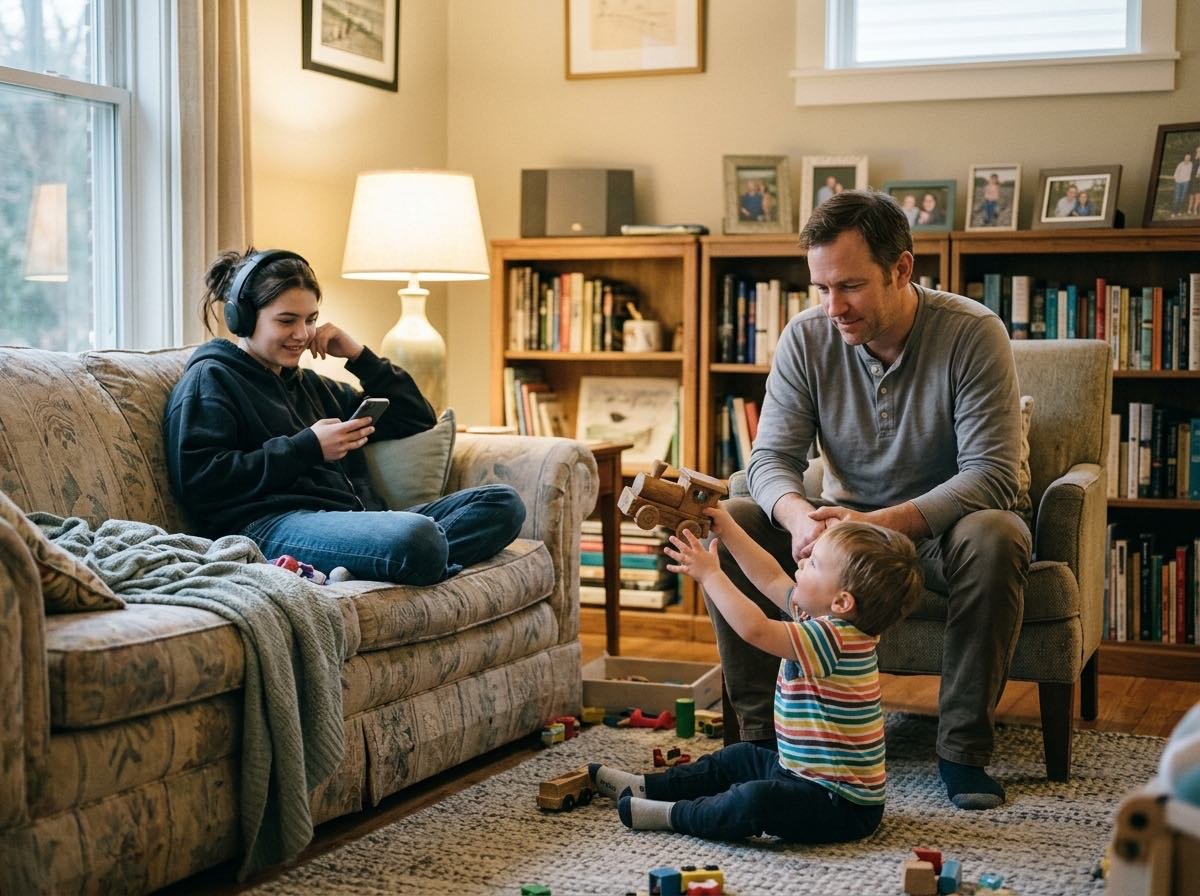
Expect what the age can deliver, not what the moment demands.
Time this week: Day 1, about 25 minutes (the tables take reading). Every other day, 10.
Why it works
Half the anger in any house comes from a spec error: demanding parts the model does not ship with. Brain construction runs bottom to top, and the last part built, the judgment and impulse wiring up front, is not finished until the mid-20s. That is not an opinion. It is on the brain scans of thousands of kids, tracked for years.
You would not run cast iron like spring steel. Same shop rule here: know your material before you work it. When your expectations match his actual equipment, half your fights dissolve before they start, because they were never fights with your kid. They were fights with a datasheet that did not exist.
The receipt: A landmark brain-mapping study followed kids for a decade and watched the judgment wiring finish last, deep into the twenties. Full citation in Sources.
Field assignments
Run your three most common fights through the age table. Verdict each one.0 / 3
Recalibrate one rule or routine to match the equipment. One line, one change.0 / 1
Catch one "he's acting his age" moment a day and let it cost nothing.0 / 7
Keep the engine: bench blocks.0 / 3
Gauge logs and ring backs when they come.0
Tap +1 each time you run a rep. Progress here is reps you logged, nothing else.
The Teach
The brain ships in stages.
The alarm and appetite systems come online early and strong. The brakes, the planner, the consequence-calculator: those arrive last, and they arrive slowly. In a four-year-old, the brakes are barely poured. In a fourteen-year-old, the engine got upgraded before the brakes did, on purpose; that is what adolescence is. Nature ships teenagers with more throttle than brake and lets experience finish the job.
What this means at your kitchen table: most of what reads as disrespect is actually construction. The meltdown is missing hardware, not missing character. The eye-roll is a new feature being tested, not a verdict on you. You still hold lines. You just stop being insulted by the equipment list.
Standard equipment is not defiance.
A 4-year-old melting down at a transition, a 7-year-old who cannot lose, an 11-year-old lawyering every rule, a 15-year-old behind a closed door: all standard, all documented, all survivable. Defiance is different: he has the skill, he knew the line, he was cool when he chose to cross it. That case exists too, and Week 10 gives you the edge for it. This week is about telling the two apart, because they get opposite responses. Equipment gaps get structure and patience. Defiance gets a calm, held line. Punishing a gap breaks trust. Excusing defiance breaks the house.
Realistic is not soft.
Expecting a 4-year-old to handle a five-step bedtime alone is not high standards. It is bad engineering, and the nightly war it produces teaches nobody anything. Cutting bedtime to two steps is not lowering the bar. It is building to spec, and to-spec structures hold. High standards live at the edge of his equipment, not past it.
What never changes with age.
Three constants at every band: your steady presence, a few clear lines held cool, and repair when things break. The equipment changes. The father does not.
A father I talked to.
I talked to a father who fought his seven-year-old every game night for a year because the boy flipped the board every time he lost. He thought he was raising a sore loser, and he brought a full lecture to every flip. Then somebody showed him where losing sits on a seven-year-old's equipment list: right at the edge, half-built. He shrank the games to five minutes, lost on purpose sometimes so the kid could watch a man lose calmly, and treated every flipped board as a rep, not a crime. He told me the boy shook his hand after a loss six weeks later, grinning like he had won. In a way both of them had.
Diagram
Casting pattern with four molds labeled 2-4, 5-8, 9-12, 13-17, each a different thickness, captioned "work to the mold you have"
The Upgrade: The Age Tables
Find your kid's band. Read all three columns. The third column is the job.
2-4: Fresh casting
Standard equipment: meltdowns at transitions and fatigue; "no" as a hobby; short memory for rules; magical thinking; regressions under stress (potty, sleep).
Not shipped yet: brakes of any kind; understanding "five minutes"; multi-step instructions; empathy on demand; calming down alone.
Work to spec: one-step asks. Routines over rules. Redirect beats lecture. Two choices, both acceptable to you. Guard sleep and food like the treasure they are.
5-8: Early temper
Standard equipment: fairness radar (for others); losing = crisis; tattling; wild imagination; lying experiments (testing how words work); hunger and fatigue swings.
Not shipped yet: losing gracefully every time; honesty under fear; long attention through boring tasks; managing embarrassment.
Work to spec: two-step asks. Practice losing in five-minute games. Treat first lies as physics experiments, not felonies: correct calm, no shame. Feed the machine before hard asks.
9-12: Alloy in progress
Standard equipment: logic arrives and gets pointed at your rules (lawyering); peer opinion rising; privacy begins; hunger for real competence; sarcasm testing; early moodiness.
Not shipped yet: adult judgment about risk; immunity to peer pull; steady emotional weather.
Work to spec: explain the why once, then hold. Hand over real jobs with real stakes. Respect the closing door while keeping the bench block daily. Lawyering is a new tool being tested; do not take the test personally.
13-17: High-carbon steel, unfinished temper
Standard equipment: eye-rolls, one-word answers, the closed door; peers over parents (biology, not betrayal); late-shifted sleep clock; risk appetite up, especially with friends watching; arguing as reasoning practice; embarrassment about you.
Not shipped yet: finished judgment under arousal (mid-20s); risk math with peers present; seeing around emotional corners.
Work to spec: fewer rules, bigger ones, held every time. Negotiate the negotiables so he learns negotiating from you. Side-by-side beats face-to-face by a mile: car rides are gold. Keep showing up through the grunts. The door closes; reliability keeps the relationship open.
The maturity-gap checklist.
Before you treat it as defiance, run five checks:
Is this on his band's standard equipment list?
Does it happen with other adults too (teachers, coaches)?
Does it shrink when he is fed and slept?
Can he do it sometimes, but not under heat? (Skill exists; regulation gap.)
Was the line actually clear, in advance, in words he understood?
Mostly yes: maturity gap. Adjust the structure, keep the patience, no penalty. Mostly no, and he was cool when he chose: that is a play, and the line holds. Week 10 covers how.
Worked Examples
Dave: building to spec
The bedtime war, month four. Dave's routine asks Josie, four years old, to run five steps solo: pajamas, teeth, potty, book choice, lights. Every night she stalls at step two and the war begins, and every night Dave reads the stall as defiance. The table says otherwise: multi-step self-management is not on a four-year-old's equipment list. He has been demanding a part the model does not ship with.
Rebuild to spec: two steps, dad runs the transitions, routine starts fifteen minutes earlier to dodge the fatigue cliff, same order every night. Choices inside the rails: which pajamas, which book. The war does not vanish; four-year-olds still have weather. But it drops from nightly to twice a week, and Dave logs the score honestly. Bad engineering was the enemy. It usually is.
Ray: the audit
Ray runs Deon's three worst habits through the 13-17 table like a parts inspection. The eye-roll: standard equipment, costs nothing today. The one-word answers: standard equipment; the table says keep showing up through the grunts, so he does, side by side, in the truck. The twenty dollars missing from his wallet with a cold, rehearsed cover story: not on any equipment list. He had the skill, knew the line, chose it calm.
Two verdicts get patience and presence. One gets a held line and a conversation at a 2 that Deon will not enjoy. That is the whole discipline of this week: stop bundling. A dad who fights everything teaches the kid that nothing matters more than anything else. A dad who saves the fight for the real thing teaches exactly where the walls are.
Fathering From Distance
Phone-only: run the call through the table too. A 6-year-old does five good minutes and is done; do not read the drift as rejection, it is attention span. A 9-year-old talks while doing something else; that is normal, keep the wire open. A 15-year-old may text more than he calls: meet the band where it lives, texts count, memes count, consistency counts. The band sets the format. You set the reliability.
Every-other-weekend: do not spend the visit demanding a performance his band cannot give. A 4-year-old will melt down Sunday afternoon no matter how perfect the weekend was; it is fatigue, not a referendum on you. A teenager will want friend time during your weekend; the table says peers-over-parents is hardware, so build one block of the visit around his world instead of fighting it.
The Rehearsal
The expectation audit.
My three most common fights, run through the table. For each: the fight, the band verdict (equipment gap or a play?), and the change, if gap.
Fight 1: _______________ · gap / play · change: _______________
Fight 2: _______________ · gap / play · change: _______________
Fight 3: _______________ · gap / play · change: _______________
One recalibration, committed: the rule or routine I am rebuilding to spec this week: _______________
The Field
The week grid
Track each day, Monday to Sunday:
"Acting his age" caught, cost nothing
Bench block done
My AM/PM #s
Recalibration check
The rebuilt rule/routine ran ___ days this week.
Fight frequency on it: before ___ per week, this week ___.
Go Deeper (optional)
What was demanded of you at your kid's age that was past your equipment? One page, once. Notice what it cost, and what you swore. This is the on-ramp to next week.
Sources
The judgment wiring finishes last: a decade-long brain-mapping study watched cortical maturation run into the mid-20s, frontal regions last. Gogtay, N., et al. (2004). "Dynamic mapping of human cortical development during childhood through early adulthood." Proceedings of the National Academy of Sciences, 101(21), 8174-8179.
More throttle than brake in the teens: reward systems mature ahead of control systems, which explains adolescent risk, especially with peers. Casey, B. J., Jones, R. M., and Hare, T. A. (2008). "The adolescent brain." Annals of the New York Academy of Sciences, 1124, 111-126.
Optional reading: the Casey paper's first two pages, if you have a teenager and need to feel better fast.
Cutting bedtime from five steps to two for a 4-year-old is...
The Shop Log
Two minutes. Numbers first, story second.
Audits done0 / 3
Age-moments caught0 / 7
Bench blocks0 / 3
Ring backs0
Look-backs
Week 5: ring backs this week so far. They work at every age band.
Week 1: your resting number. Calibration matters more as the kid's band gets older.
Week rating
1 did not open the book · 2 read it, barely ran it · 3 most reps done · 4 all reps done · 5 all reps plus one hard save under fire. A week holds at 3 or better.
The Brief, back page
Expect what the age can deliver, not what the moment demands.
You now hold the datasheet most fathers never get handed. Equipment gaps get structure. Plays get held lines. And a big share of what used to light your gauge turns out to be a kid doing exactly what kids his age do, which means it stops costing you heat at all.
Next week in one line: The deep session: where your defaults came from, and the page where you redesign them. Six weeks of your own numbers say you are ready for it.