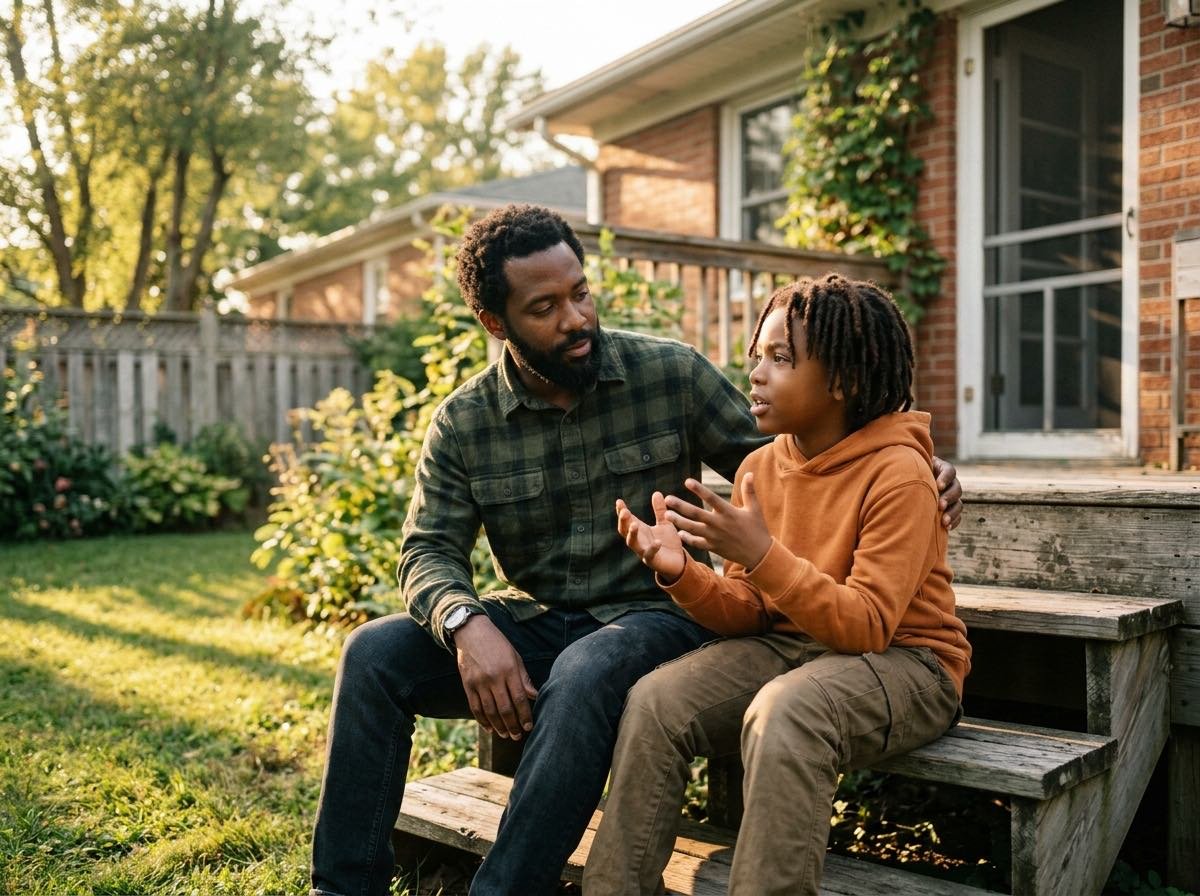
The eight plain words.
Mad. Sad. Scared. Ashamed. Hurt. Alone. Stuck. Glad. That is the whole vocabulary this course asks of you. No feelings wheels, no fifty-cent words. Eight words a man can say in a truck with a straight face, and a kid can learn before kindergarten.
Most men were raised with a vocabulary of two: fine, and mad. Everything soft got translated to mad on the way out, because mad was the one feeling a boy could show without paying for it. You know how that translation works. You have watched it run.
Feelings are alloys.
Pure anger is rare. Almost every anger you have ever felt was carrying something under it: hurt riding as rage, fear dressed up as fury, shame with its fists up. The mad is real, but it is the coating, not the core. This week, once, when you feel the mad arrive, run the check: what else is in this metal? Say the truer word, even just to yourself. Naming the coating cools it a little. Naming the core cools it a lot.
All feelings are legal. Not all moves are.
Your kid is allowed to be furious. He is not allowed to hit. You are allowed to be hurt. You are not allowed to disappear for three days. Feel anything; do what is right. Say that sentence in your house this week, and then live like it is true, because a kid who learns that feelings are illegal does not stop feeling them. He just stops filing reports.
They learn the words by hearing you use them.
Not on them: "you're obviously ashamed" is a diagnosis, and nobody thanks the man who diagnoses them. On yourself: "I'm frustrated about work, and under it I'm worried. Not about you." One plain word a day about your own weather, said out loud, in front of the kid. That is the whole modeling program. It costs one sentence and it is the most contagious thing you will do all course.
Ring Back: prove receipt.
When he brings you heat, hurt, a big ask, or an accusation, do not respond first. Ring it back: the core of what you heard, one or two plain sentences. "You're saying I care more about work than your games." Then check: "Did I get that right?" Let him correct you; the correction is gold, it means he is now explaining instead of attacking. THEN respond.
Ringing back is not agreeing. You can ring back "you think this rule is garbage" and keep the rule. What you are proving is that the message arrived, and here is the trade secret: a kid will take a no he was heard on better than a yes he had to fight for. So will a grown adult on the other end of a text thread, which becomes very useful in Week 9.
A father I talked to.
I talked to a father whose thirteen-year-old told him, mid-argument, "you don't listen, you just wait to talk." It landed because it was true; he had been loading his rebuttal since her second sentence. The next fight, he tried the dumb-sounding thing: said her point back to her before he answered it. He told me she stopped mid-breath and said "yeah, exactly," and the fight lost half its temperature on the spot. She did not need to win. She needed to be received.
DiagramCross-section of a bar of metal labeled MAD on the coating, with core layers labeled hurt / scared / ashamed
Ring Back
Prove receipt before you respond.
- 1. He says it. Heat, hurt, a big ask, an accusation. The harder it lands, the more this tool matters.
- 2. You ring it back. The core of what you heard, one or two plain sentences. "You're saying ___."
- 3. Check it landed. "Did I get that right?" Let him fix it. The correction is gold.
- 4. Then respond. Fix, decide, hold the line, or just stay with it.
What it is not: parroting his words like a machine, agreeing, or caving. Heard is not agreed.
Where it works: face to face, on the phone, and on hostile texts, where you ring back only the legitimate question buried in the jab, answer that, and let the rest die in the drafts folder.
RING BACK
1. He says it.
2. You say back the core, plain. "You're saying ___."
3. "Did I get that right?" Let him fix it.
4. Then respond.
Heard is not agreed. He takes a heard no better than a fought yes.
Cool it. Connect. Then correct.
The eight plain words, printed for the fridge: mad · sad · scared · ashamed · hurt · alone · stuck · glad
Marcus: "I hate you"
Sunday, 5:50 pm. Bags by the door, ten minutes to handoff. Eli, out of nowhere, kicking the duffel: "I hate you. I want to stay at mom's."
Every one of those words is a knife, and old Marcus would have bled all over the room: "After the weekend we just had?" A defense. A counterattack. A guilt trip. Pick any of them, they all end the same way: a kid crying in a booster seat and a father gripping a steering wheel.
New Marcus reads himself: 3, hurt spiking toward 4. One long exhale. Then the ring back, low and plain: "You're saying leaving stinks, and you're mad at me because I'm the one packing the bag." Beat. "Did I get that?"
Eli's face crumples. "I don't want to go." Not hate. It was never hate; hate was the loudest word a six-year-old had for grief. Marcus does not fix it, because it is not fixable; the schedule is the schedule. He sits on the floor next to the duffel and takes it: "Yeah. Leaving stinks. I hate that part too. Sad and mad at the same time is a real thing." Two plain words, said by dad, about dad. The handoff still happens. It happens with a kid who got received instead of corrected.
Tony: the games
The Thursday call, and Mia comes in loaded: "You never come to my games. Ava's dad comes to everything."
Tony has a defense, and every fact in it is true: six hundred miles, the schedule, the money, who moved where and why. He has delivered that defense before. It has never once worked, because she was not filing a complaint about logistics. She was saying something with a truer word underneath it.
Ring back first: "You're saying it hurts that I'm not in the bleachers like the other dads. That you look over and I'm not there." Silence on the line, the kind that means it landed. "Yeah." What follows is the best eleven minutes they have had in a month, and it includes exactly zero logistics. At the end Tony makes one small, keepable promise: the next game that streams, he watches live, and calls right after. The problem did not get solved tonight. The kid got heard tonight. Those are different jobs, and this week you learn to do the second one first.
Ray: one word at dinner
Nothing is wrong tonight, which is exactly why Ray runs the rep. Over tacos, unprompted: "I'm frustrated about a thing at work. And under it I think I'm worried. Not about you. Just saying it out loud instead of stomping around about it."
Deon does not look up from his plate. No reaction whatsoever. Rep logged anyway.
Wednesday, three days later, Deon, grabbing his backpack: "I'm stressed about the algebra test." Four words, unprompted, plain, accurate. That word did not come from school. The vocabulary is catching, exactly the way the gauge said his calm was catching. You model it, you wait, and it walks back in the door wearing your kid's voice.
Fathering From Distance
Phone-only: Ring Back is the single best phone tool in this course, because the wire strips away everything except words and tone. When she brings heat down the line, ring it back before you solve it. And do your daily plain word on the call: "Long day. I'm tired and a little stuck on a work thing. Anyway, tell me about the tryout." One sentence of weather, then her.
Every-other-weekend: the last hour of the visit is where the big feelings live, usually dressed as attitude. Expect one hard sentence near the bag-packing ("I hate this," "why do you even bother"), and have the ring back pre-loaded like an if-then: "You're saying the leaving part stinks." Do not argue with grief. Receive it. It is the most fathering you will do all weekend.
Ring back skeletons.
Fill in for YOUR kid, from real recent history:
- When he says: "_______________" (his most common hot sentence)
- I ring back: "You're saying _______________."
- When he says: "You never / you always _______________"
- I ring back: "You're saying _______________. Did I get that?"
My alloy check. Last time I hit a 4, the coating was mad. The core, honestly, was probably: hurt / scared / ashamed / alone / stuck
My daily weather line (one plain word about me, said in front of my kid): "I'm _______________ about _______________. Not about you."
The week grid
Track each day, Monday to Sunday:
- Ring back done
- My plain word said aloud
- Kid's # at flashpoint
- Bench block done
The alloy spot (once this week)
- The moment: _______________
- The coating: mad, obviously.
- The core (circle): hurt · scared · ashamed · alone · stuck
- Did naming it change the cool-down? Y / N
Go Deeper (optional)
Write about the feeling your father never said out loud, and what he did instead. One page, once, private. Then notice which of his translations you still run.
- Naming quiets the alarm: labeling an emotion in words reduced amygdala response in brain imaging. Lieberman, M. D., et al. (2007). "Putting feelings into words: Affect labeling disrupts amygdala activity in response to affective stimuli." Psychological Science, 18(5), 421-428.
- Kids whose parents coach emotion in plain language regulate better, do better with friends and school, per longitudinal work. Gottman, J. M., Katz, L. F., and Hooven, C. (1996). "Parental meta-emotion philosophy and the emotional life of families." Journal of Family Psychology, 10(3), 243-268.
Optional reading: none. Say the words instead.
Battle-buddy ping template: "Week 5. Ring backs: ___/7. The word under my last mad was: ___."