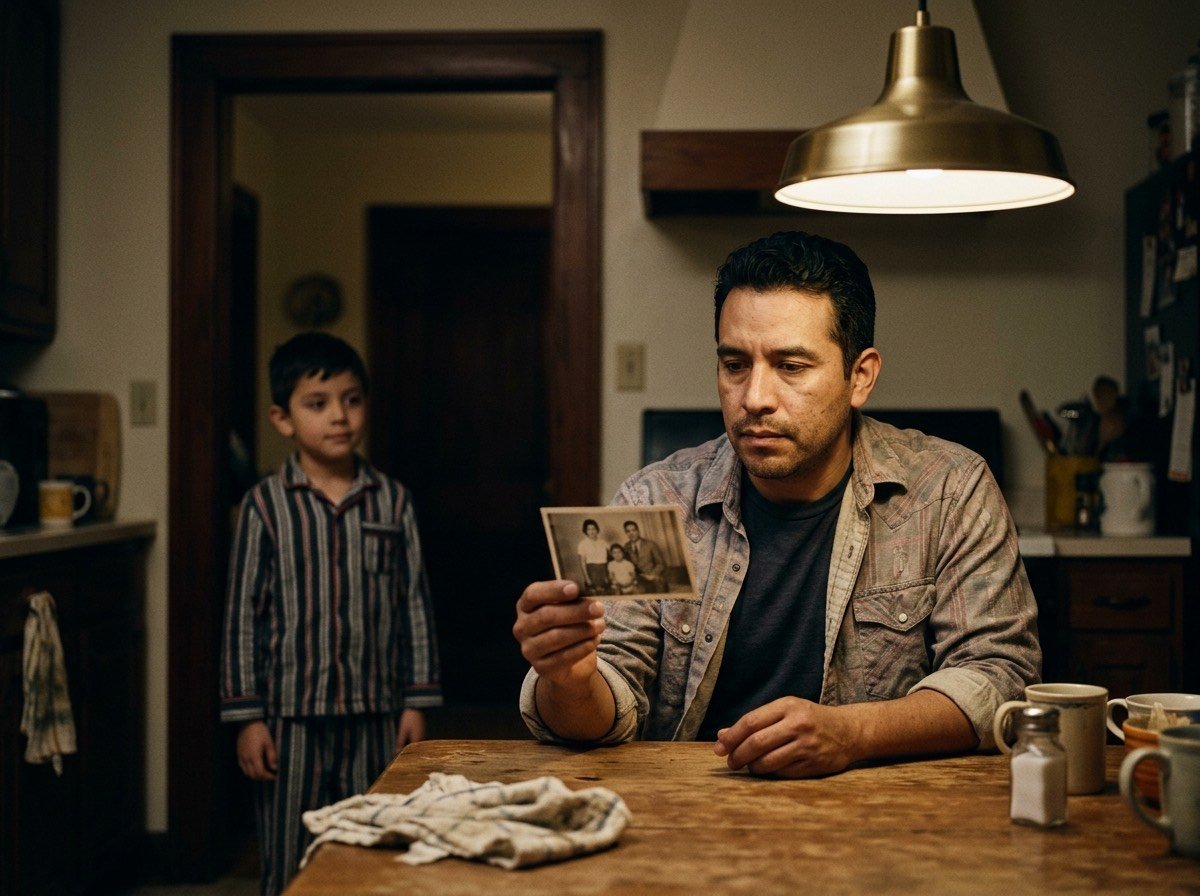
You did not cut the pattern you were cast from. You cut the next one.
Time this week: One deep session, 25 to 30 minutes, once. Everything else runs light: 5 to 10 minutes a day.
Why it works
Before anything else, look at your numbers. Six weeks in. Open your Shop Logs and add it up: ___ quenches, ___ bench blocks, ___ welds, ___ ring backs, longest streak ___. Those are not feelings. Those are receipts. You have already changed how your house runs. That is exactly why this week is safe to do now: we are not digging to find out if you can change. You already proved that. We are digging so the change holds under pressure.
Every man learned fathering somewhere, mostly by watching, before he was ten. Under pressure, that training runs automatically, which is why the words that come out of you at a 4 sometimes arrive in your father's voice. Here is the finding that should take the weight off your chest: what predicts your kid's security is not what happened to you. It is whether you have made sense of it. Men from brutal childhoods raise secure kids all the time. The ones who do have one thing in common: they can tell the story straight. A story you can tell straight is a story that stops repeating.
The receipt: Longitudinal attachment research found that a parent's coherent account of his own childhood predicts his kid's security better than the childhood itself did. Full citation in Sources.
Field assignments
The Pattern diagnostic, once. 25-30 minutes, private. (The week's one long block.)0 / 1
The Keep / Scrap / Recut page.0 / 1
Catch your watch-for move live, once this week, and choose different. Log the catch.0 / 1
Engine runs light: gauge logs daily.0 / 7
One bench block minimum. That is all that is required.0 / 1
Tap +1 each time you run a rep. Progress here is reps you logged, nothing else.
The Teach
Not to blame anyone. To take the controls.
Get this straight before the diagnostic: this page is not a trial of your father. Whatever shop you trained in, the men who ran it were usually running the training they got, with less help than you have right now. Blame is a dead end that keeps you a passenger. This is about taking the controls: you cannot redesign a pattern you refuse to look at.
How the pattern got cut.
Kids wire their expectations of closeness from repeated experience. Thousands of small moments taught your body what happens when you need someone: whether comfort came, came sometimes, came with a price, or did not come. That wiring is not a diagnosis and it is not destiny. It is a default setting, and defaults only run until a man installs something else. You have spent six weeks installing something else. Now we look at the default so you can see it coming.
The shop you trained in.
Five shops, described on the tool card. Read all five slowly. Check every one that rings; most men trained in more than one. And read them the way they are written, gave-first, because every shop, including the hard ones, issued you real equipment. Self-reliance, radar, standards, fire, adaptability: those came from somewhere. The goal is not to torch your inheritance. It is to sort it: keep, scrap, recut.
The watch-for is the payoff.
Each shop has a signature move that fires under pressure. The Cold Shop goes silent. The Loud Shop jumps 2 to 4 with no middle gear. The Drill Floor coaches when the kid needs comfort. The Empty Shop swings between too soft and too hard. The Fog Shop stirs the pot when things get quiet. Once you can name your move, you can catch it live, and catching it live is the entire game. One catch this week. That is the assignment.
Making sense beats making excuses.
The research standard for "made sense of it" is not forgiveness, and it is not feeling fine about it. It is coherence: being able to say what happened, what it gave you, what it cost you, and what you are doing about it, in plain order, without the story running you. That is exactly what the diagnostic builds. Four boxes, one page, your history organized into something you operate instead of something that operates you.
A father I talked to.
I talked to a father who swore his whole life he would never be his old man, and then heard his old man's exact sentence come out of his own mouth at his son, word for word, same doorway, same tone. It broke something loose in him. He told me later that hating his father had never once stopped the sentence from coming, but naming the pattern did: the next time he felt it loading, he caught it at the jaw, quenched, and said something his own. He said it felt like the first sentence he had ever written himself.
Diagram
Casting pattern being traced onto new stock, old pattern faded behind it, captioned "trace what serves, redraw what doesn't"
The Tool Card
The Pattern
The shop you trained in is not the shop you have to run. Check every shop that rings. Most men check more than one.
The Cold Shop.
Distant. Unexpressive. Feelings were furniture nobody moved.
Gave you: self-reliance. You do not fall apart.
Cost you: ease with closeness. Warmth feels like a foreign language.
Watch for: going silent exactly when your kid needs words.
The Loud Shop.
Volatile. Eggshells. You learned to read a room before you could read a book.
Gave you: fast, accurate room-reading. You see storms coming.
Cost you: a hair trigger of your own.
Watch for: heat jumping 2 to 4 with no middle gear.
The Drill Floor.
Demanding. Love felt earned, never given.
Gave you: standards, work ethic, follow-through.
Cost you: worth that feels tied to performance, yours and his.
Watch for: coaching when the kid needs comfort.
The Empty Shop.
Father gone. Died, left, or never showed.
Gave you: the fire to be different. You are here, which proves it.
Cost you: no template. Every move is improvised and second-guessed.
Watch for: swinging between too soft and too hard, because you never saw the middle.
The Fog Shop.
Unpredictable. Addiction, mood swings, good days you could not count on.
Gave you: alertness, adaptability, radar.
Cost you: trust in calm. Quiet feels like the setup before the hit.
Watch for: stirring conflict when things finally settle, because calm feels wrong.
THE PATTERN
The shop you trained in is not the shop you have to run.
Cold. Loud. Drill Floor. Empty. Fog. Check what rings.
Every shop gave you something. Keep it.
Name the watch-for. Catch it live. Choose different once this week.
Cool it. Connect. Then correct.
Worked Examples
Sam: two shops
Sam reads the five and checks two without hesitating: the Empty Shop (his father left at seven) and the Fog Shop (what came after was not steady). Gave: the fire to be different, and radar that reads a room in half a second. He has used both his whole life. Cost: no template, and a nervous system that treats quiet like a loaded gun.
Thursday night at the house, everything is finally calm: Caleb asleep, dishes done, nothing wrong. And Sam feels it start, the itch to pick at something, check something, start something, because calm was never safe where he trained. This time he has a name for it. Fog Shop, right on schedule. He logs the catch, runs a quench he does not technically need, and lets the quiet stay quiet. On the Keep/Scrap/Recut page: keep the radar, scrap the pot-stirring, recut the vigilance into the nightly two-minute log. The fire that made him different stays. It just gets a firebox.
Marcus: the middle gear
Marcus checks the Loud Shop and feels the old defensiveness rise, because checking the box feels like accusing his dad, and his dad had his own shop to survive. He reads the gave-line again: fast, accurate room-reading. True. He has walked into rooms his whole life and known the weather in one breath. That skill came from somewhere, and it cost what it cost: 2 to 4 with no middle gear.
His recut is already six weeks old, he just never called it that: the Quench is his middle gear now, retrofitted where the factory never installed one. His logs prove it runs: eleven live saves and counting. On Saturday he catches the watch-for live, jaw tight over spilled paint, heat jumping, and takes the gear instead of the jump. Catch logged. The pattern did not vanish. It just stopped being in charge.
Fathering From Distance
Phone-only: patterns show up in how you run the distance. Cold Shop dads let the calls go quiet and tell themselves the kid is busy. Drill Floor dads turn every call into a report card check. Fog Shop dads start something the night before the visit. Name your shop's distance move and write one if-then against it: "If I want to skip the call because it feels pointless, then I dial anyway and run five minutes."
Every-other-weekend: the Empty Shop move on a visit is the swing: theme-park dad Saturday, drill sergeant Sunday, because no one ever showed you the middle. The middle is built from parts you already own: one bench block, a few lines held cool, the send-off ritual. Boring, steady, repeatable. That IS the template. You are cutting it now, and your kid is watching you cut it.
The Rehearsal: The Diagnostic
The week's one long block. 25-30 minutes, private, one sitting, phone in the other room.
Step 1. Check your shops
Cold / Loud / Drill Floor / Empty / Fog
Step 2. For each checked shop, one line each:
What it gave me that I still use: _______________
What it cost me: _______________
My watch-for move, in my words: _______________
Step 3. Tell it straight (four boxes, one or two lines each).
This is the coherence work. Plain order, no drama, no defense:
What happened in my shop: _______________
What it gave me: _______________
What it cost me: _______________
What I am doing about it now (name the tools): _______________
Step 4. Keep / Scrap / Recut.
KEEP (serves my kid): _______________
SCRAP (ends with me): _______________
RECUT (reshape into something useful): ______________ becomes ______________
Step 5. Load the catch.
My watch-for will probably fire this week at: _______________ (situation). When it does, my counter-move is: _______________ (quench / set line / cooling assist / say the plain word).
Done. Close the book. Go do something with your hands.
The Field
The light week grid
Track each day, Monday to Sunday:
AM/PM #s
Bench block done
Watch-for fired? Y / N
Caught it? Y / N
One caught watch-for makes the whole week. More is gravy. A fired watch-for you only noticed afterward still counts as progress: noticing afterward is how noticing-during gets built.
Go Deeper (optional)
Write the story of your shop once, one page, start to finish, using the four boxes as your outline. Some men burn the page after. That is allowed. The point was never the paper.
Sources
The wiring is real: decades of observation established how kids build expectations of closeness from repeated caregiving experience. Ainsworth, M. D. S., Blehar, M. C., Waters, E., and Wall, S. (1978). Patterns of Attachment. Erlbaum.
The story you can tell straight: parents' coherent narratives of their own childhoods predicted their children's security across studies. Main, M., Kaplan, N., and Cassidy, J. (1985). "Security in infancy, childhood, and adulthood." Monographs of the Society for Research in Child Development, 50(1-2), 66-104.
Earned security is real: adults with hard histories who made sense of them parented like secure adults. Roisman, G. I., Padron, E., Sroufe, L. A., and Egeland, B. (2002). "Earned-secure attachment status in retrospect and prospect." Child Development, 73(4), 1204-1219.
Optional reading: none this week. The diagnostic was the reading.
Battle-buddy ping template: "Week 7. Deep week done. My shop: ___. My watch-for: ___. One catch logged."
Your watch-for fires and you only notice afterward. That is...
The Shop Log
Two minutes. Numbers first, story second.
Diagnostic done0 / 1
Keep/Scrap/Recut done0 / 1
Watch-for catches0
Bench blocks0
Look-backs
Week 4: the weld exists because patterns break through sometimes. Welds banked so far.
Week 1: your set line, from memory. It is also the counter-move to most watch-fors.
Week rating
1 did not open the book · 2 read it, barely ran it · 3 most reps done · 4 all reps done · 5 all reps plus one hard save under fire. A week holds at 3 or better.
The Brief, back page
You did not cut the pattern you were cast from. You cut the next one.
The hardest page in the course is behind you, and you did it with receipts already in hand. You know your shop, you know its gifts, you know its move, and you caught it live at least once. From here on, the defaults do not run you. You run them.
Next week in one line: Your own anger, straight on: what it carries, where to route it, and why it is fuel and not a flaw.