Your sparks keep a schedule.
Run last week's log back. Where did your 4s happen? Odds are they cluster: the same doorway, the same hour, the same name on the phone screen. That is not bad luck. That is a pattern, and patterns can be worked.
A man who knows his sparks stops being ambushed by them. The ambush is half the damage. When the spark is expected, the jaw-set becomes a signal instead of a hijack: there it is, right on time, and I already know my move.
The if-then plan.
Pick a spark. Decide the exact move you will run when it fires. Write it as one sentence: if X happens, then I do Y. "If the handoff runs late, then I run three exhales at the last red light and say only the pickup time." "If the bedtime callbacks start, then I stop on the landing and quench before the door."
Say it out loud twice. Under flood, your brain does not invent; it loads whatever is already there. An if-then plan is you, cool and smart, leaving instructions for you, hot and dumb. Trust the cool version. He thinks better.
The machine needs maintenance.
Here is the part most courses skip because it is not glamorous: your temper rides on your body. Short sleep alone can crank the brain's alarm response by more than half. Add skipped meals and zero movement, and you are walking around two rungs higher on the gauge before anything even happens. A man running on five hours and gas-station food is not fighting his kid at bedtime. He is fighting his own chemistry, and losing.
So this week adds three boring checkboxes: sleep 7 or more, move 20 minutes, eat real food. Not a fitness plan. Regulation infrastructure. You maintain the truck that carries your family. Maintain the man.
About discipline, since it is on your mind.
The full system for rules and consequences arrives in Week 10, built properly. Until then, run the interim rule: fewer rules, enforced calm, every time. Do not add new rules while you are retooling. Hold the two or three that matter, at a 2, without speeches. Consistency at low heat beats intensity at high heat every single week of the year.
A father I talked to.
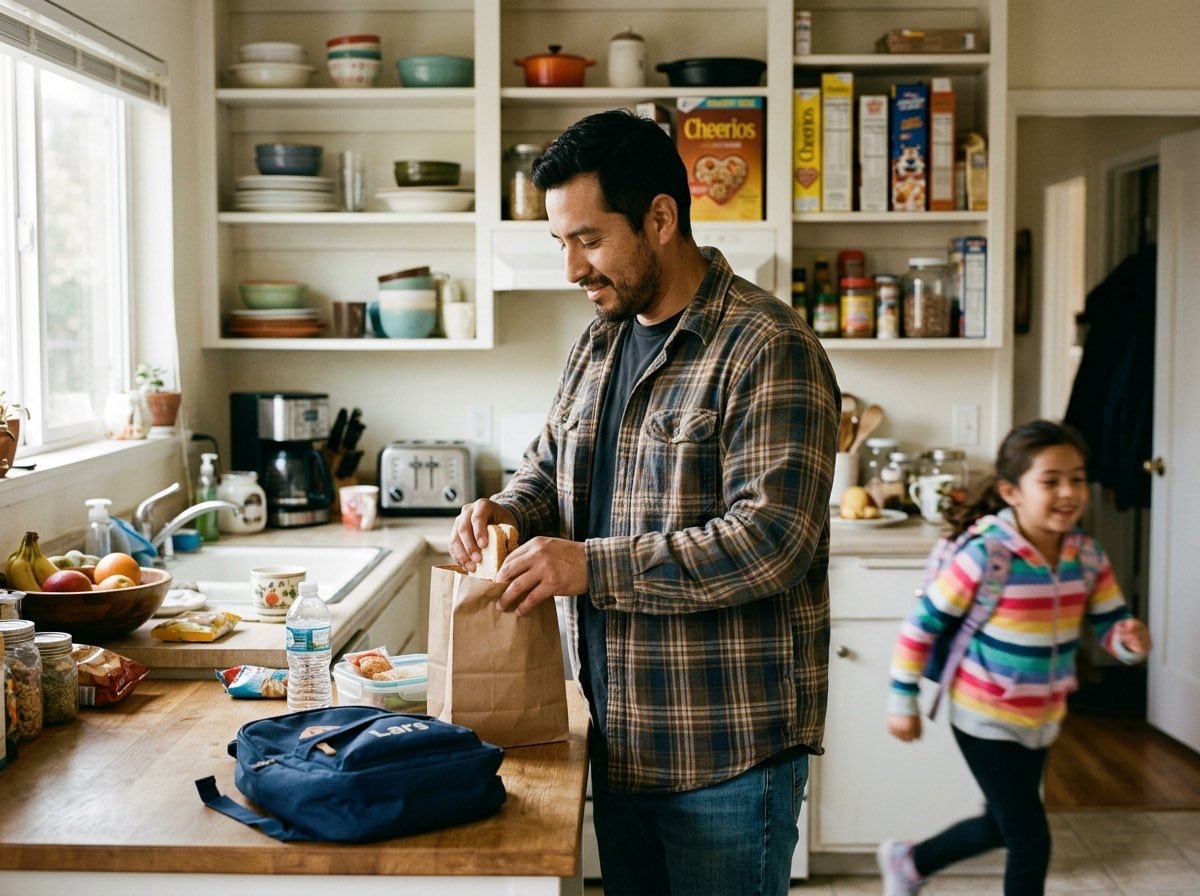
I talked to a father whose worst spark was 7:15 on school mornings. Same fight, every day, for a year: the backpack, the cereal, the clock. He wrote one if-then: if it is 7:10 and the shoes are not on, then I put the timer on the counter and go start the truck instead of standing in the kitchen narrating. He told me the fight did not end that week, but his part in it did. By Friday the timer was doing the yelling, and nobody had to.
This week is reps, not novelty.
No new tools. The Quench only gets fast enough to matter through repetition, and the gauge only gets accurate through daily reads. Boring is the point. Nobody ever got steady hands from an exciting week.
DiagramFirebox with three fuel lines labeled sleep, food, movement, and a valve labeled if-then plans
No new tool this week. Two upgrades to the ones you own.
Heat Gauge upgrade: find your resting number.
After ten or more logs, you know it. Most tired men idle at 3 and call it normal. If your mornings start at 3, you are one bad text from a 4 before breakfast. The body basics below are how you buy your idle back down to 2.
Quench upgrade: cut the reload.
The flood fades in ninety seconds unless you refuel it. The reload is the replay: rehearsing the comeback, re-reading the text, narrating the case against them in your head. When you catch the replay starting, name it ("reloading") and put your eyes on something in the room. Count the exhale again. You cannot stop the first wave. The second wave is optional.
Tony: the 5:41 text
Thursday. The call with Mia is at 6:00. At 5:41 his phone buzzes: the summer schedule, again, with a jab riding on it. Old pattern: thumbs first, hot reply by 5:44, three more rounds by 5:55, and then he dials his daughter at a flat 4 and wonders why the call dies in six minutes.
New pattern, planned Tuesday while cool: if her text lands within 30 minutes of the call, then it waits until 7:00, no exceptions. The phone goes face down. Quench at 5:55. He reads his number: 3, workable. Dials at 6:00.
The call runs nine minutes and Mia does most of the talking. At 7:00 he re-reads the text, and it turns out to be one real question wearing armor. He answers the question in two lines. The if-then did not make him calmer. It made the decision before the flood could vote.
Ray: the 7:15 scramble
Ray maps his sparks Monday night and there it is in ink: every school morning, 7:10 to 7:25, the missing backpack, the full cereal bowl, the locked bathroom door with Deon and his phone behind it. A year of identical fights. Seeing it written down costs him something. It also hands him the schedule of the ambush.
His two if-thens: if it is 7:10 and Deon is not moving, then one sentence through the door, "Truck leaves at 7:25," and dad walks away from the door. If the eye-roll comes at breakfast, then it costs nothing today; that fight is not worth the morning.
Wednesday it works. Thursday it does not: Deon misses the truck and takes the late slip. Ray lets the late slip do the talking and says nothing on the drive. That silence at a 2 is not weakness. It is the interim rule running: fewer rules, calm enforcement, and reality allowed to collect its own fee.
Fathering From Distance
Phone-only: your spark map probably has one giant entry: messages from her, and the minutes before and after calls. Write the if-then that protects the call window (nothing gets read within 30 minutes of dialing), and one that protects your evenings (messages after 9 pm wait for morning). Your body basics matter double: nobody regulates well at midnight on five hours of sleep, and distance dads do their fathering at fixed clock times that do not care how you slept.
Every-other-weekend: map the re-entry sparks. The first hour of the visit (kid testing, dad overeager) and the last hour (the goodbye wall) are where your 4s live. If-then for each: if the first hour goes sideways, then bench time, not a lecture; if the last-hour silence comes, then the send-off script, same words every time. Rituals are if-then plans your kid can see.
The spark map.
Check every situation that has produced a 4 in the last month. Add your own.
- Handoffs / exchanges
- Bedtime callbacks
- School-morning scramble
- Backtalk / the tone
- Texts or calls from the co-parent
- Money conversations
- Homework standoffs
- Screens and shutoff time
- The quiet treatment
- Other: _______________
Circle the two that fire most often. Those two get if-then plans today.
- If-then plan 1: If _______________, then I _______________.
- If-then plan 2: If _______________, then I _______________.
Say both out loud twice. Cool you is leaving instructions for hot you. Make them short enough for hot you to follow.
The week grid
Track each day, Monday to Sunday:
- AM # and PM # (your two gauge logs)
- Cold drill done
- Live saves
- Slept 7+, moved 20, ate real food
If-then tally
- Times a mapped spark fired this week: ___
- Times the planned move ran: ___
- Ambushes (unmapped sparks): ___ (add them to the map)
Go Deeper (optional)
Pick the spark you circled first. Write out its full anatomy once: what happens ten minutes before it, who says what, where your body goes, how it usually ends. Men who can narrate a pattern cold usually stop running it hot.
- If-then plans: deciding the when-where-how in advance roughly doubled follow-through across dozens of studies. Gollwitzer, P. M. (1999). "Implementation intentions: Strong effects of simple plans." American Psychologist, 54(7), 493-503.
- Sleep and the alarm system: one night of sleep deprivation amplified the brain's threat response by roughly 60 percent on brain scans. Yoo, S.-S., Gujar, N., Hu, P., Jolesz, F. A., and Walker, M. P. (2007). "The human emotional brain without sleep: a prefrontal amygdala disconnect." Current Biology, 17(20), R877-R878.
Optional reading: Walker, M. (2017). Why We Sleep. Scribner. (The chapter on emotion is enough.)
Battle-buddy ping template: "Week 2. Two if-thens loaded: ___ and ___. Body boxes so far: ___/21."